Showing posts with label bootleg. Show all posts

Tuesday, October 2, 2018

Sader

Just look at those eyes ♡

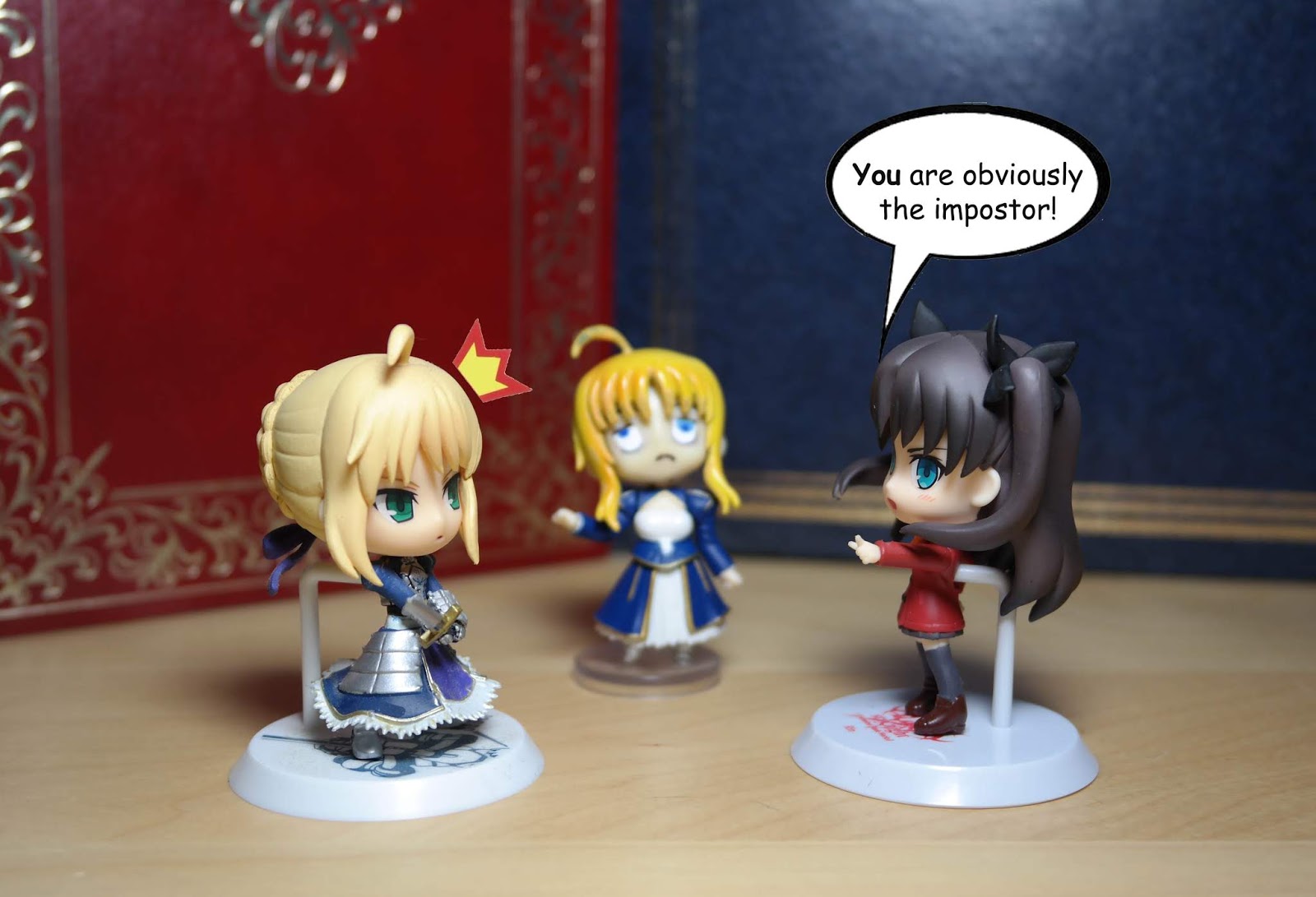
Sader is often described as a poorly done bootleg, but she is actually a shanzhai figure. She was never meant to be passed off as the actual Clayz figure she was modeled after, except in the minds of those who only know of her from stories filtered through the lens of anti-bootleg propaganda.

The original figure was a bonus included with a Fate/Stay Night special issue of the magazine Donghua Jidi (動画基地). For a mere 30元 (~US$4), you could get the magazine and a small scale replica of a figure that sells for ¥6,400 (~US$60).

Here's my theory on what happened during the production process for the figure:

The publisher commissions a figure to include as a giveaway for their magazine.

The sculptor is familiar with anime and really likes the 1/6 Clayz Saber figure, so he makes a scaled down version of it for the publisher.


The publisher okays the prototype, and sends it to the manufacturer who has a shallow understanding of anime figures. "Got it. Those big-eyed Japanese cartoon characters for kids, right?"


The production instructions are drawn up, and get handed down to the workers on the manufacturing line. These folks don't know Saber from the Lizard Queen, and have been painting Simpson's figures day in, day out for the past 10 years.


The end result is Sader.


Despite all the scorn that is heaped on Sader, I have a soft spot for her. I kinda wanted the figure, but since I'm only interested in petits, I knew I would have to make my own version.

I started out with a bootleg petit of Fate Testarossa, and removed her twin tails and cut off the back of her hair.


Then I used rubbing compound to remove the eyes from the figure.


I prefer using rubbing compound to acetone or lacquer thinner (the method popularized by Kahotan's Blog) because it does not dissolve the PVC and leave behind a slick melted surface.


Underneath the painted eyes there were red and purple imprints that had leeched into the PVC. Not a big deal since I could paint over the color, but it would cause some issues with how I was going to achieve the half lidded look of Sader's eyes.


I painted in the whites of the eyes, but the eye proportions of a petit are rather different from scale figures so I couldn't really get the proper shape that I wanted. I had to draw in some lines with a Sharpie in order to pull off something approaching a half lidded appearance.


Next I painted in the pupil and iris of each eye, and her mouth. I cut the pointy ends off of her bangs, and added an ahoge made of Kneadatite. I didn't  really get the cock-eyed look of the real Sader, but it's close enough for me.


I think I have a small plastic knife from a Warhammer miniature that I can use as a weapon for my Sader petit (if I can ever find it among my many bitz boxes).


Sunday, October 25, 2015

Touhou Shushuroku Bootlegs

The Touhou Shushuroku figures from Toranoana are not particularly well known, and often command a fairly high price on the resale market (particularly for the later releases). A few bootleg figures exist, but all are from the more readily available "Volume 1" set.

The bootlegs have many minor differences in appearance and engineering, which seem to suggest that they were sculpted using the originals as models. They are sold glued and assembled, whereas the original figures come disassembled (when new).

I'd classify these as shanzhai figures due to the obvious differences in the way they were manufactured.

The figure stands for the bootleg figures are all identical. A sliding peg allows a single post to be used for any figure (left). The originals all have stands that are individually matched to each figure (right).


The first comparison is of Hakurei Reimu. The bootleg (left) is not too shabby, though the paint job is obviously not as well done. Her shoes are unpainted.


Notice how there is no separation in the ponytail for bootleg Reimu.


The stick on bootleg Reimu's gohei is bent because a softer PVC is used to manufacture her.


Bootleg Marisa (left) does not come with a hat or mushroom. The paint job is so-so, and details such as the buttons of her blouse are not picked out. Her shoes and socks are both painted black.

Marisa, Marisa, Marisa!!!!!!

Bootleg Marisa has a peg built into the hem of her skirt to keep her on her stand. The original (right) has the peg on the stand, which fits into a socket in the hem of her skirt.


Bootleg Marisa does not have any apron strings. Note how the hair on the bootleg is a lot softer in definition.


Next is Princess Kaguya. Bootleg Kaguya (left) has Marisa's mushroom attached to her skirt for some reason.


Is she supposed to be displayed together with bootleg Marisa?


An odd vignette... I prefer the intended configuration of the originals.


Anyway, bootleg Kaguya has a peg built into her skirt to allow her to be attached to a base. Her shoes are also unpainted.


The differences in the patterns on Kaguya's skirt are very telling between the bootleg and the real figure.


Bootleg Patchouli Knowledge (left) is also not very convincing. Note the difference between the sculpt of the hands, the lack of shading, and lack of print on the cover of the book on bootleg Pache.

Mukyuu...

Bootleg Pache has a peg located on her underside to attach her to a stand. There is absolutely no painted detail underneath.


Ribbons are sculpted as part of the bonnet and hair for bootleg Pache. Again, the paint job is poorly done.


Bootleg Chen (left) is okay. Her hair is not the right color, and her socks and shoes are both painted the same color. Her posture seems different from the original figure (right).

Chen!!!!!!!

The tip of bootleg Chen's tails are black, and there is no shading for the color transition to the tip of her ears.


Bootleg Cirno (left) looks self-satisfied, but the original Cirno (right) looks downright smug. The bootleg's skirt is not properly painted.

To be a genius like me, you have to do your best!

Bootleg Cirno's bow seems to sit higher up on her head, and her wings are not translucent.


Komachi is the last figure comparison. Again, the hair is not as well defined in bootleg Komachi (left). The decorations on her hair ties are not painted, so they are the same color as her hair. The bootleg wears a toothy grin, whereas the original has an open-mouthed smile.


Bootleg Komachi holds her scythe with the blade up, while on the original (right) holds her scythe with the blade down. Again, the soft PVC makes the staff bend quite a bit (though the original has a bit of bend as well). The stitching on the sides of her skirt is not painted on the bootleg.


Bootleg Komachi's shoes are not painted, and she has a part number "5" engraved on the inside of her skirt.


Bootleg Komachi's stand peg fits into the back of her hair. For the original figure, it fits into a hole in her bloomers, and is hidden by her skirt.


The final figure of the set was Flandre Scarlet, but I did not bother doing a comparison because bootleg Flan was missing one of her wings.


They did a nice job with the translucent material, and they're actually a lot more robust than on the original figure.

In any event, I plan on using most of these bootlegs for gaming; something I would never dare use the originals for.


Sunday, August 9, 2015

山寨

邪神セイバー

Almost all figure collectors use the word "bootleg" to refer to figures that are surreptitiously produced by various [Chinese] manufacturers, but I think that a more proper term taken from the Chinese would be "shanzhai".


Shanzhai is a term that has recently started to be used in English, and is literally translated as "mountain village" or “mountain stronghold”. It is said that the name is an allusion to the Water Margin (水滸傳), a classic 16th century novel about outlaws who establish their own mountain society in opposition to the central government.

The term was originally coined in Cantonese to refer to small family operated manufacturers who made various types of generic low-end or counterfeit products.

Since then, shanzhai has evolved to acquire new definitions that also connote imitation, parody, and improvisation. A couple of sites that have interesting articles on shanzhai include the Pacifica Literary Review, and IDEO.

Patchi (パッチ) is a similar term from Japan used to refer to knockoff products based on tokusatsu shows.

I like the use of the term shanzhai as opposed to bootleg because the manufacturers of these figures do not try to hide the fact that the figures are not authentic. The context is similar to the use of shanzhai to refer to celebrity impersonators. To me, true bootlegs attempt to disguise their origins.

The line between shanzhai and bootleg are blurred because of sellers (not manufacturers) who try to pass off both types of unauthorized products as authentic, but for most people I guess the point is really moot.

★ ☆ Sader ♡ ♥

The most [in]famous version of a shanzhai figure is "Sader", which was bundled as a bonus with an equally unauthorized Fate/stay night magazine. Aside from the crude appearance, there is no way the 3" tall figure would be confused with the original 1/6 scale Clayz figure, even if Sader looked more like her prototype.

True to the "so bad it's good" trope, Sader has gained a loyal following, and I have a feeling that her figure may even be more in demand than the original Clayz figure.

Sader Sentai

On eBay, shanzhai figures are described in the product description as "China Version", and are a fraction of the cost of an authentic figure. If you think the price is too good to be true, then you are probably looking at a shanzhai figure. Sometimes, the cost of the figure will be in proportion to how close the shanzhai figure is to the original in terms of materials and production quality, but the buyer will have to verify with pictures of the actual product.

I will often buy shanzhai figures for use in making conversions, or for replacement parts.

Miku is missing a hand and needs a replacement.

They are also good for use in gaming, since certain players can be heavy-handed or just plain jackasses when they handle figures.

Shanzhai figures are typically more robust than authentic figures, as they often are pre-assembled and glued together. This is an advantage, since figures like early Nendoroid Petits are not really suitable for gaming, because their limbs fall off at the slightest touch.

In any event, the producers of legitimate figure do not lose a sale when I buy a shanzhai figure. By the time I typically envision a conversion, the figures I want to use are already OOP and only available in the aftermarket.

Speculators and re-sellers may complain because shanzhai figures can lower prices in the aftermarket, but I could care less. If you want to invest in something, get into the stock market. The appreciation in value of an anime figure will do nothing towards your retirement plan.